Circular economy training for schools and universities
Most sustainability sessions leave students with a definition. Ours leaves them with a method — because they had to use it.
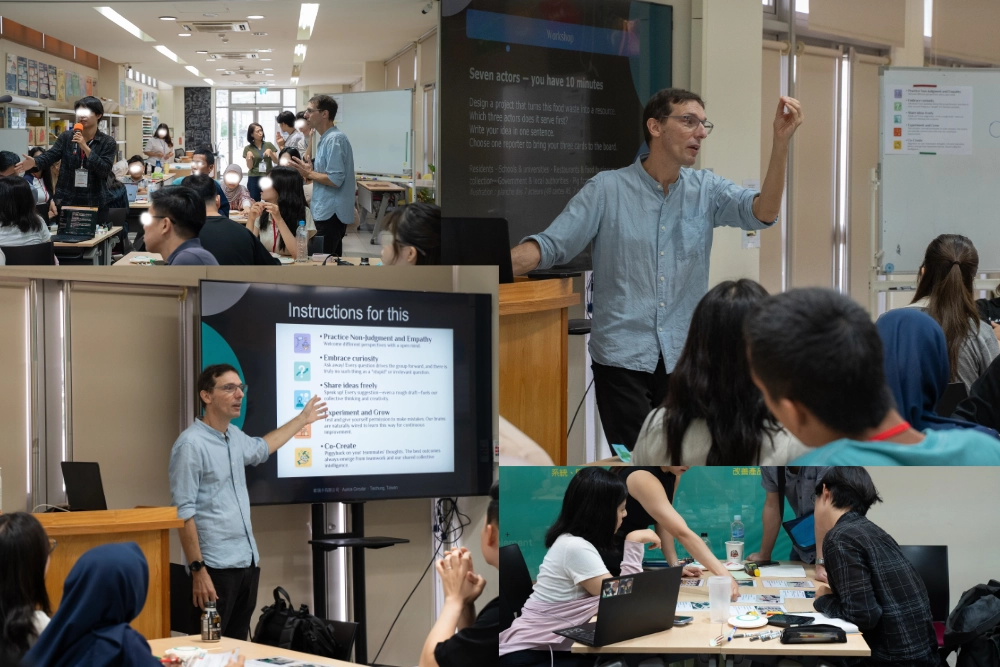
Participants vote, disagree, redesign an everyday object out loud and defend competing views of what “success” means. What they produce during the session is part of the content. The room gets noisy. That is the point.
What each participant walks out with
- A question they can apply to any product: why does this object exist in this form?
- A way of reading the flows around them — who could use what I throw away, what could I use from what others discard
- The realisation that impact is not a truth but a decision, and that they are the ones choosing the lens
- The permission to start with what they have, where they are
What it produces: the 4 September 2026 session
Three hours for an international green leadership programme in Taichung, delivered in English.
We open with a single question: “what does circular economy mean to you?” Everyone answers live, and the answers appear on the wall.
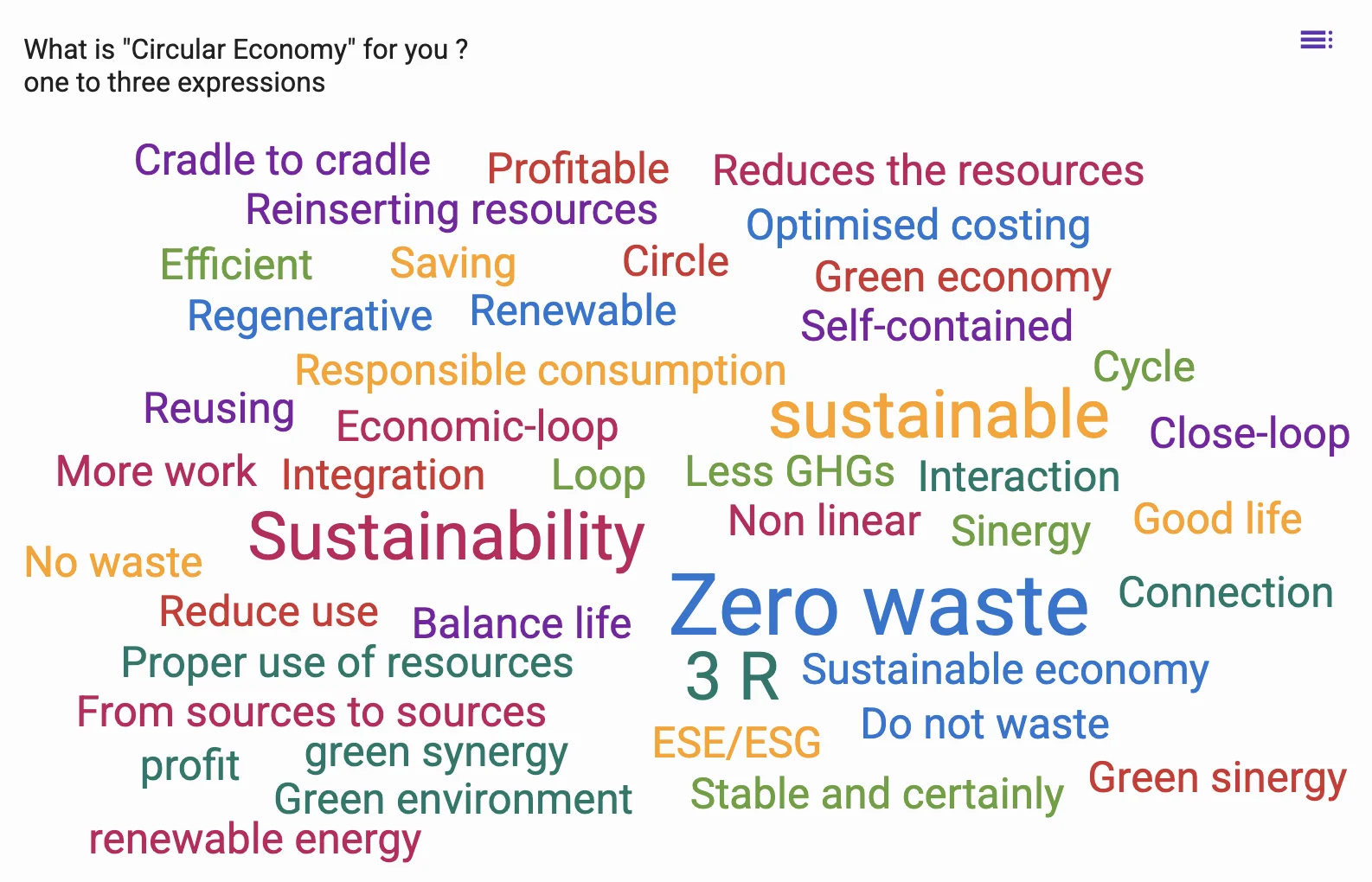
Before the session. Materials, techniques, costs.
Three hours later, the same question, asked word for word.
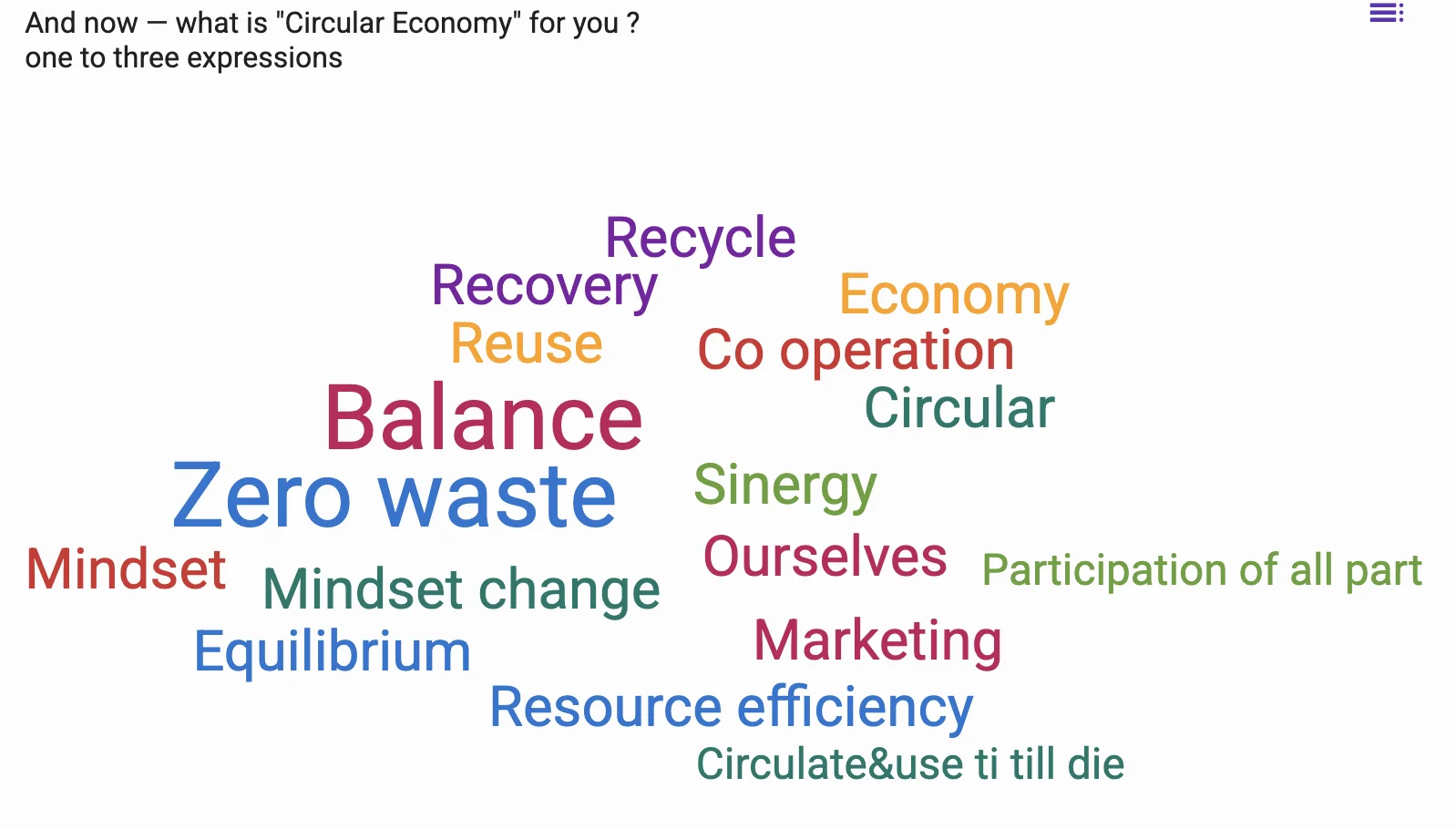
After. “Zero waste” still holds its place — but around it are words that were not there in the morning: mindset change, ourselves, co-operation, participation of all.
That shift is exactly what the session is for. You walk in thinking circular economy is a matter of materials and processes; you walk out knowing it is first a matter of decisions and people — yourself included.
At the end, 25 participants rated the workshop from 1 to 5: 48% gave it a 5, 32% a 4, the rest a 3. Nothing below.
Formats
- Conference-workshop — 90 min. Fits an existing course slot. The full loop, condensed.
- Half day — 3 h. Every angle explored, extended group work, applied to your own campus. Written report handed to your institution.
- Full day — 6 h. Each group leaves with a costed, argued circular project of their own.
- Train the trainer. We hand over the facilitation guide, the materials and the coaching, so one of your faculty can run the module themselves, as often as they like.
Practical
Delivered in English or French. On site anywhere in Taiwan, or remote. Sessions for France and Europe are online only — we are based in Taichung, and a long-haul flight for a three-hour class would contradict everything the session says.
Examples come from Taiwan and the region, not from a generic international case-study catalogue.
Designed for an international green leadership programme in Taiwan, and delivered for the first time in Taichung on 4 September 2026.
We are not here as people who succeeded, but as people who are trying — and that is exactly what makes students start something instead of admiring someone.