
BSF composter
🔧 At design stage. The prototype is still under study.
Since the African Swine Fever restrictions of late 2025, the food-waste channel to pig farming is closed: the problem is back in the buildings. Our answer: a simple, robust machine that does its job from the first week.
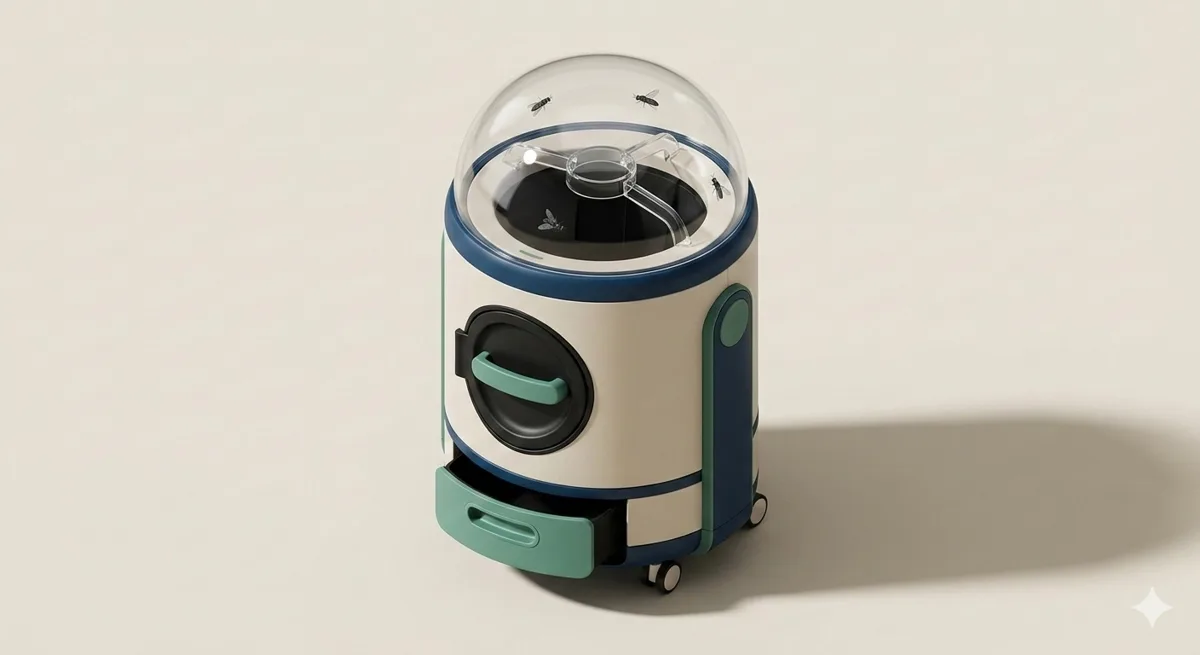
Design concept — the production unit may differ.
What we are aiming for — design targets drawn from the scientific literature:
- Sealed outdoor unit with mechanical ventilation
- Black Soldier Fly larvae: eventually processing 20 kg of food waste per day, for a 70-household residence
- Maintenance of around 15 minutes per week — a working assumption, entirely unproven
- Safe access for harvesting the outputs
Connected monitoring will come later, as an option — designed with our first users, according to demand and viability.
Where we stand
The project was fully reworked in September 2026. Fabrication is stopped, and we will not restart it before bringing in two skills we lack:
- A biologist or entomologist, to answer our questions on the viability of the black soldier fly life cycle. That is the heart of the problem: we would rather have it validated before building.
- An engineer, to draw up the machine’s plans with us.
We are also looking for investors and incubators.
We are keeping open the option of testing a first prototype in a residential building.
We would rather put it this way than display progress we do not have. Make the right thing the easy thing — true for sorting waste, true for the machine too, and precisely why we do not want to design it alone.
If you are an engineer, a biologist, an investor, or if you support projects at this stage: this is exactly the moment to write to us.
Frequently asked questions
Does it smell?
This is one of our priority design objectives.
The composter is designed to be sealed: watertight, but not airtight. Two things work in our favour. Digestion by black soldier fly larvae is fast and happens in the presence of air — unlike putrefaction, which is slow, deprived of air, and responsible for the smells we associate with food waste. And the unit is designed closed, with mechanical ventilation. Bad smells indicate an imbalance, a sign that something is wrong inside the composter. We commit to stepping in quickly.
We cannot prove it yet: there is no prototype. It is one of the first things we will measure.
What happens to the larvae?
This is one of the questions we want to settle with an entomologist before we build. We would rather not announce an outlet we have not yet secured.
What the scientific literature we rely on says: digestion by the larvae substantially cleans up what comes out of the process. That is what sets it apart from simply feeding food scraps to an animal — and what makes outlets conceivable.
Which ones are workable here, in Taiwan, and within a residential building remains to be determined. This is exactly the kind of question we are looking for partners to answer.
How much time does it take?
We are aiming for something in the order of fifteen to thirty minutes a week, harvesting included. It is a working assumption drawn from the literature, and it remains entirely unproven on a full-scale machine.
This figure is not a comfort detail: it is the threshold beyond which a residential building stops looking after it. If it turns out to be out of reach, it is the design that will have to change, not the instructions given to residents.
When will it be available?
We are aiming for a first machine in the first half of 2027.
That objective depends on the partnerships we are currently seeking and putting in place.