
Taiwan is closing the pig-feed route. Where will 2,100 tonnes of food waste go each day?
By Philippe BERTIERI 江樂田, founder of Aurica Circular — September 2026
On 4 December 2025, the Executive Yuan adopted a report that quietly redraws Taiwan’s waste landscape. From 1 January 2027, no kitchen waste may be used to feed pigs. Household waste has already been excluded since 1 January 2026; 2026 is a transition year, under strict conditions, for commercially sourced waste alone.
The reason is sanitary — African swine fever — and the decision makes sense. But it closes a route that had absorbed a considerable share of the island’s organic matter for decades.
The timetable is tight. The Ministry of Environment estimates that national facilities currently handle around 1,720 tonnes per day across all routes — anaerobic digestion, composting, black soldier fly conversion. By the end of 2027, capacity should reach 2,119 tonnes per day, against an estimated daily output of 2,115 tonnes.
Four tonnes of margin. For an entire island. Provided every announced project is delivered on time.
And the cost has already moved. Before October 2025, treating food waste cost a private producer roughly NT$4 per kilo. By June 2026, the press was reporting NT$9–12 for restaurants. In Taichung, one building in Xitun district went from NT$2,000 to NT$14,000 a month. These figures are market observations rather than an official schedule — but their direction is not in doubt.
In other words: the question is no longer theoretical or distant. It is already on the invoices of schools, restaurants, hotels and residential buildings.
The problem is not the waste
This is where the framing deserves to shift.
Food waste is mostly water. It is collected daily because it ferments. It is loaded onto a truck. It is transported. Then, at best, it is treated; at worst, it is landfilled — where it generates methane — or incinerated — where what burns is water.
Either way, what that material contained disappears. Nitrogen, phosphorus and potassium leave the Taiwanese agricultural cycle. And Taiwanese agriculture buys them back afterwards, as imported fertiliser.
That is what a linear economy is: a resource moved at great expense in order to be destroyed, then repurchased elsewhere under another name.
So the question facing Taiwan is not only “where do we treat these 2,100 tonnes”. It is: where does this material have to go in order to remain a resource?
What changes when the question changes
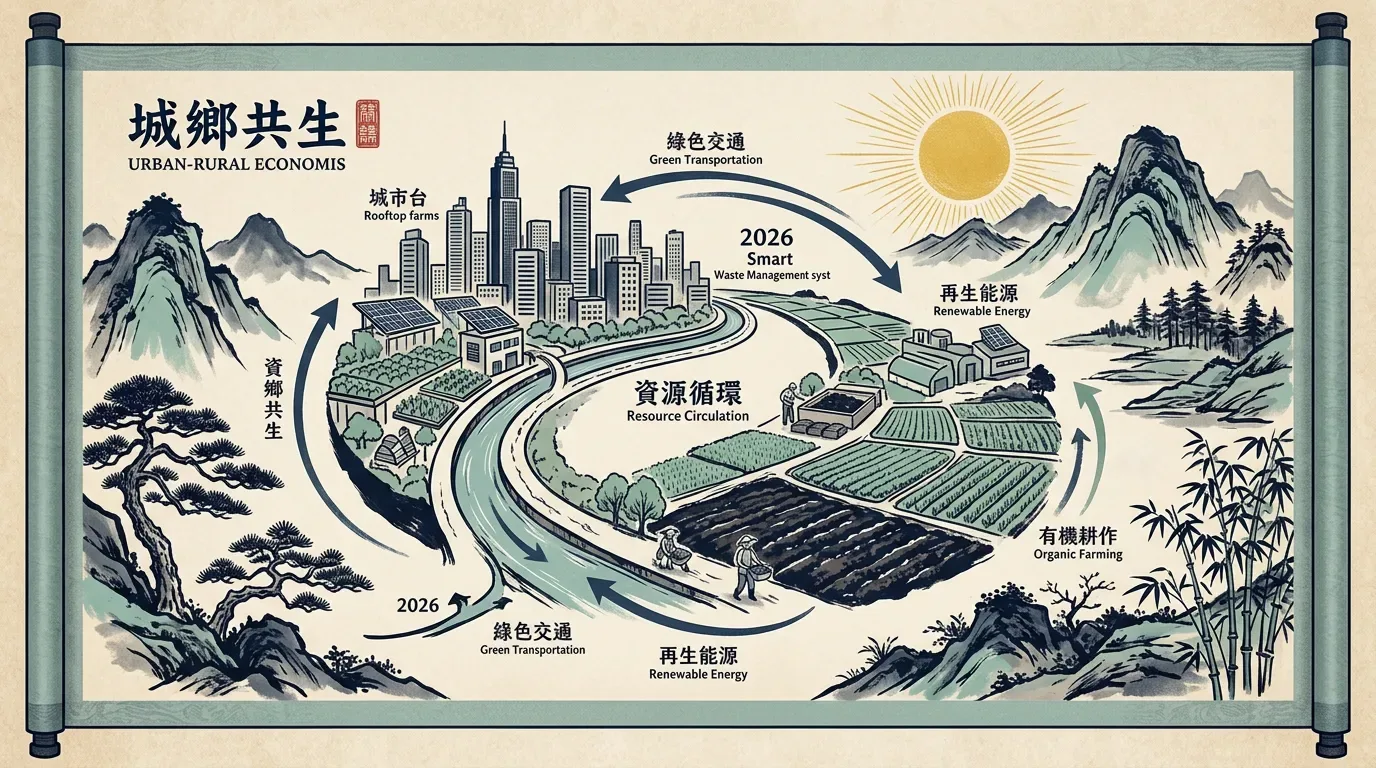
Framed as a treatment problem, the answer is industrial: build more facilities, larger ones, and organise the logistics that feed them. That is necessary, and it is being done.
Framed as a question of where material should go, the answer changes in nature. It asks about the distance between where waste appears and where it becomes useful again. It asks what we are transporting: water, or value. It asks who decides — a municipality, or whoever produced the waste.
And it surfaces something logistics tends to hide: the further waste travels, the more it costs and the less it is worth.
That is the circular economy principle itself, and it is less a matter of technology than of geography and decision. The question is not which process is best — anaerobic digestion, composting and insect conversion each have their domain. The question is how far from the producer the loop should close.
Taiwan has until 1 January 2027 to answer. That is tomorrow.
Aurica Circular is a Taiwanese company based in Taichung, working on applied circular economy and training organisations to think in loops rather than straight lines.
Sources
- Executive Yuan, report on adjusting the kitchen-waste pig-feeding policy in response to African swine fever, 4 December 2025 — CNA
- Ministry of Environment, treatment capacity estimates, 2025-2026 — UDN, Newtalk
- Collection costs: Taipei Times, 12 June 2026; bnext, 2026; knews (Taichung)